Why construction’s biggest commercial failures often happen long before a claim is written, and what both contractors and employers can do about it in one of the world’s most challenging project environments.
There is a widely held belief in the construction industry that a claim is what you reach for when everything else has failed. It is the last instrument in the box: uncomfortable, adversarial, and best avoided for as long as possible. This belief is understandable. It is also one of the most commercially damaging assumptions in the industry, and in the South African context, it carries a cost that extends well beyond individual projects.
The reality is that by the time most contractors formally initiate a construction delay claim or disruption claim, the conditions for its success have long since passed. Notices have expired. Records are incomplete. The causal chain, once clear and traceable, has become entangled in months of programme drift, informal agreements, and undocumented variations. What should have been a well-substantiated entitlement becomes an exercise in reconstruction, and reconstruction is an exercise that rarely ends well.
This is not primarily a legal problem. It is a management problem. And it affects both sides of the contract in ways that neither typically acknowledges.
Claims Management Is Not a Response to Project Failure; It Is a Form of Project Management
The distinction matters enormously. A contractor who waits until the project is in distress to consider a claim is not being prudent; they are being negligent toward their own commercial position. The events that give rise to a claim, late design information, unilateral scope changes, restricted access, and employer-caused disruption, do not announce themselves as claim events. They arrive as operational problems, absorbed by the site team in the moment and forgotten by the time anyone thinks to record them.
Every construction contract in common use, whether JBCC, FIDIC, NEC, or GCC, contains mechanisms to address these events in real time. Notice provisions, early-warning obligations, and compensation event procedures: these are not bureaucratic formalities. They are instruments of contemporaneous record-keeping, and they only work if they are operated as the project runs, not assembled after it derails.
“The programme and the claim are the same document, read in different contexts. If your programme is accurate and your records are clean, your claim practically writes itself.”
Consider what it actually means to issue a timeous notice under FIDIC’s Sub-clause 20.2, or to follow the principal agent notification procedure under the JBCC Principal Building Agreement. It means that within a defined window of becoming aware of a delay event, the contractor communicates its existence, its likely impact, and its cause to the other party. That communication is, in fact, a service to the project. It forces early decision-making. It prevents small problems from compounding into large ones. It creates a shared record that both parties can rely on if the situation escalates.
The contractor who issues notices promptly and consistently is not the difficult one. They are professionals. The contractor who absorbs every employer-risk event silently for nine months and then arrives at practical completion with a six-figure claim is the one who has created an adversarial situation, not by claiming, but by waiting.
Grounded In Reality
What This Looks Like on a South African Construction Site
A mid-size contractor is appointed under a JBCC Principal Building Agreement for a commercial fit-out in Gauteng. Three weeks in, the principal agent issues a revised layout drawing requiring the contractor to reconfigure work that is already substantially complete in one section. The site manager adapts. The team reworks the section. A note is made in the site diary, “revised drawing received, rework underway,” and the project continues.
At week eleven, the contractor is four weeks behind programme. The cause is a combination of the week-three rework, two further late drawing issues, and a delay in electrical clearance caused by the employer’s nominated subcontractor. None of these events were formally notified. The principal agent attributes the delay to the contractor’s resourcing. A claims consultant is appointed.
The consultant asks for contemporaneous records supporting each delay event. The site diary entries are brief and operational. There are no formal notices. There is no impacted programme. The claim that follows is largely narrative. It is assessed as unsubstantiated. The contractor absorbs the loss, not because they weren’t entitled, but because they weren’t ready.
The events in this scenario are real in the sense that they are entirely ordinary. They happen across hundreds of projects every year. What is notable is not the employer’s conduct or the contract terms; it is the operational gap between what happened on site and what was recorded. That gap is where claims go to die.
A Uniquely South African Pressure
When The Threat Is Not in The Contract
South African construction operates under pressures that are unusually acute by global standards. Load-shedding, supply chain fragility, skills shortages, and escalating material costs have made delivery genuinely difficult for over a decade. But there is one pressure that standard claims literature, written largely for international or Western markets, does not address at all: the organised disruption of construction sites by groups collectively known as the Construction Mafia.
This is not a peripheral issue. It is a structural reality of project delivery across large parts of Gauteng, KwaZulu-Natal, and the Eastern Cape, and its commercial consequences are severe, poorly understood, and almost entirely unaddressed by existing contract frameworks.
The Construction Mafia: Disruption, Entitlement, and The Contract’s Blind Spot
The Disruption
The term “Construction Mafia” is commonly used to describe organised criminal networks, often operating under the guise of community liaison or local business forums, that use intimidation, threatened or actual violence, and coordinated site stoppages to extort payments from contractors and developers. Their demands typically centre on compulsory subcontracting arrangements, enforced procurement of local labour and materials at inflated rates, and direct cash payments framed as “community levies.”
Site stoppages lasting days, weeks, and, in some cases, months have been documented across public infrastructure projects, private developments, and large-scale energy installations. Workers are intimidated off sites. Plant and equipment are damaged or prevented from operating. In the most severe cases, the physical safety of site personnel has been directly threatened. The effect on the programme is immediate and often catastrophic.
The Commercial Consequences
A contractor on a road infrastructure project in KwaZulu-Natal experiences a complete site stoppage following demands from a local business forum. The stoppage lasts six weeks. During this period, the contractor continues to incur standing time costs: labour retained, plant standing idle, and preliminaries running while no productive work is possible. The employer acknowledges the disruption informally but declines to issue any formal instruction. No variation is issued. No extension of time is granted. The contractor absorbs the cost, attempts to accelerate, and arrives at project close having absorbed losses running into several million rands, none of which is recovered, none of which is on record.
This pattern is not unusual. The commercial consequences of Construction Mafia disruption are routinely absorbed rather than claimed, for reasons that are partly legal, partly practical, and partly cultural. Contractors fear that raising a formal claim will provoke further intimidation. Employers are reluctant to acknowledge a disruption event on their project record. And both parties are operating in a contractual framework that was not designed for this category of risk.
The Systemic Problem – Where Contracts Fall Short
Standard construction contracts allocate risk on the assumption that delay events are either employer-caused, contractor-caused, or force majeure in nature. The Construction Mafia does not fit neatly into any of these categories. Under FIDIC, a contractor may seek to argue that organised site disruption constitutes an exceptional event under Sub-clause 18.1, but the threshold is high and the procedural requirements are strict. Under JBCC, relief may depend on the particular version of the agreement, the wording of the force majeure or similar relief provisions, and whether the procedural requirements have been met.
The result is a risk that is effectively unallocated. It sits in the space between the contract’s categories and is often absorbed in practice by the party least able to resist absorbing it, which is usually the contractor. Every stoppage event, its start date, duration, cause, programme impact, and all communications surrounding it, must be recorded with the same rigour as any other delay event. The record supports a contractual claim, provides evidence for legal proceedings, establishes a basis for insurance recovery, and creates the project history that any future dispute will rely on. A stoppage that is not recorded is a loss that cannot be recovered by any mechanism.
Framework For Both Parties
What Live Claims Management Requires
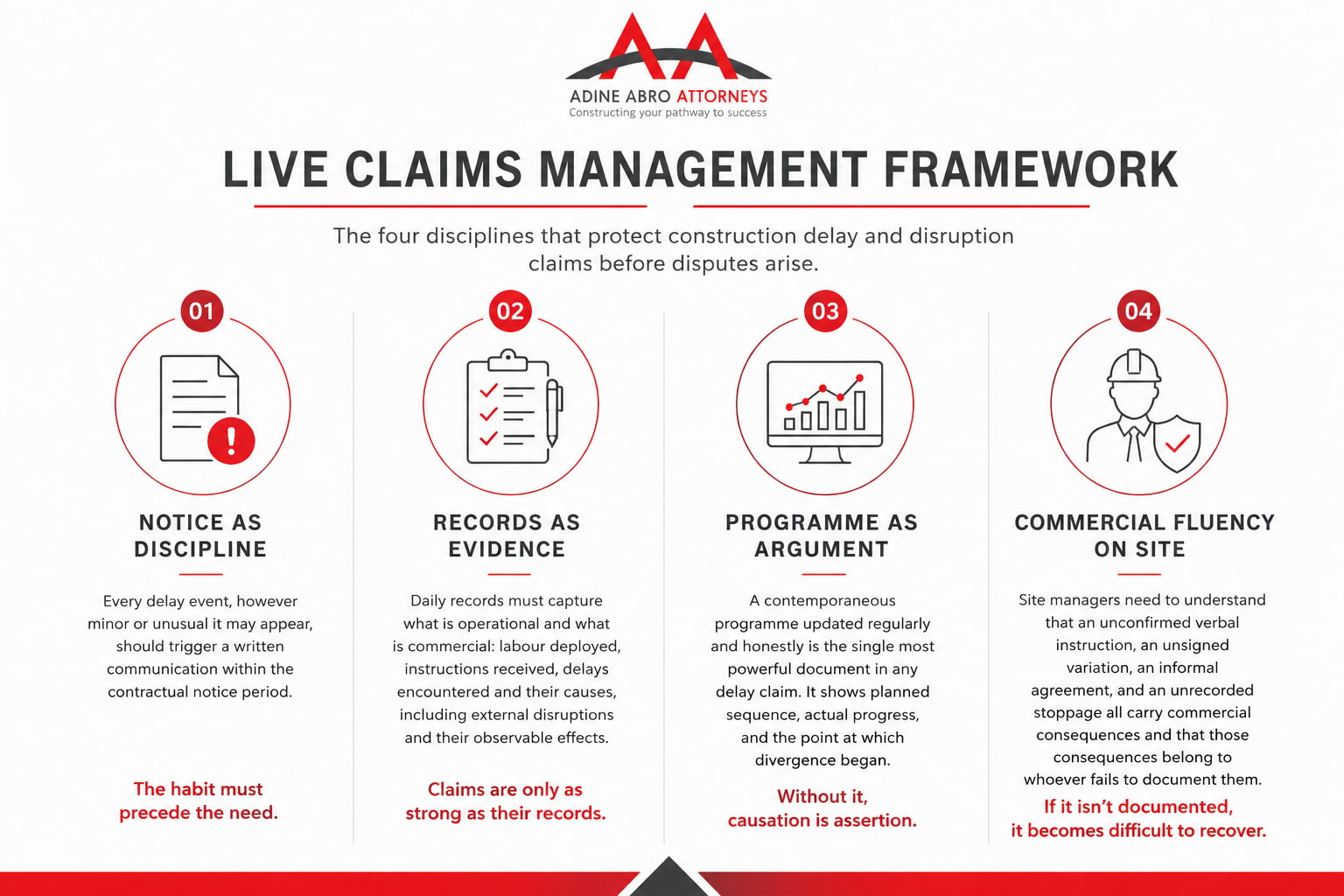
Converting construction claims management from a reactive function to an embedded one is not a matter of adding paperwork. It is a matter of aligning the commercial and operational layers of project delivery so that they inform each other continuously. The following principles apply regardless of contract form, project scale, or the nature of the disruption encountered.
- Notice As Discipline
Every delay event, however minor or unusual it may appear, should trigger a written communication within the contractual notice period. The habit must precede the need. Waiting to assess impact before notifying is the most common and most costly mistake.
- Records As Evidence
Daily records must capture what is operational and what is commercial: labour deployed, plan within a contractual framework ructions received, delays encountered and their causes, including external disruptions and their observable effects.
- Programme As Argument
A contemporaneous programme updated regularly and honestly is the single most powerful document in any delay claim. It shows planned sequence, actual progress, and the point at which divergence began. Without it, causation is assertion.
- Commercial Fluency on Site
Site managers need to understand that an unconfirmed verbal instruction, an unsigned variation, an informal agreement, and an unrecorded stoppage all carry commercial consequences and that those consequences belong to whoever fails to document them.
Both Sides of The Contract
This Is Not Only a Contractor Problem
Employers and their professional teams carry an equal share of responsibility for the claims environment on their projects. A principal agent who fails to respond to a notice within the prescribed period, issues instructions without acknowledging their time and cost implications, or manages the programme through informal conversations rather than contractual mechanisms, is not reducing disputes. They are deferring them.
An employer who receives a timeous notice should respond promptly, substantively, and in writing, as required by the contract. Employers who create cultures of responsive contract administration that treat a contractor’s notice as project intelligence rather than an opening salvo experience fewer disputes. And those who formally acknowledge disruption events, including Construction Mafia stoppages, protect both parties from the consequences of an unallocated risk sitting silently on the books.
Practical Application
A Minimum Standard for Any Project
- A designated commercial lead responsible for tracking delay events, including external disruptions, and issuing notices within contractual timeframes from the first day of mobilisation.
- A site diary format that captures commercial as well as operational information: labour, plant, access, instructions, and any disruption to normal working is completed daily.
- A baseline programme updated regularly to reflect actual progress, with deviations and their causes noted at the time they occur, not reconstructed weeks later.
- A written instruction procedure ensuring every variation, scope change, and employer instruction is confirmed in writing before work proceeds or stops.
- A stoppage register specific to the SA context recording every site disruption event: its date, duration, stated cause, persons involved, communications made, and programme impact.
- A monthly commercial review assessing the live claims position alongside the programme, integrated into standard project reporting, not activated only when things go wrong.
The South African construction industry operates under pressures that are genuinely without parallel in most global markets. Some of those pressures, criminal disruption, infrastructure failure, and economic volatility, sit outside the boundaries of what any contract was designed to manage. But the response to all of them, without exception, begins in the same place: a clean, contemporaneous, commercially aware project record.
The construction industry will always produce delay and disruption. The question is not whether claims will arise; it is whether the parties will be able to deal with them fairly, efficiently, and on the basis of an accurate record. That record is built on-site every day by people who may never read a contract clause in their lives. Getting it right is not a legal challenge. It is a leadership one.
The claim you never made was not lost in arbitration. It was lost on a Tuesday afternoon, when something happened on site, whatever that something was, and nobody wrote it down.