
By Adine Abro | Attorney, Construction & Public Procurement Law | April 2026
In the competitive arena of public procurement, particularly in the construction sector, where margins are tight and contract values run into the hundreds of millions, the ability to participate in a tender process is not merely a business opportunity. It is a strategic asset. Every bidder who enters a procurement process does so with a clear commercial objective: to win the contract at the best possible price. Against this backdrop that a question at the intersection of public law, contract law, and commercial strategy has proven to be one of the most persistently litigated and consequential issues in South African procurement law.A question with profound implications for organs of state, bidders, and the constitutional principles that govern public spending alike.
The question is this: when a procuring institution asks bidders to extend the validity period of their tenders, is a bidder legally obliged to say yes?
The short answer is no. But it is the consequences of that “no” that this article is concerned with. South African procurement law, shaped by conflicting judicial decisions , has created a legal framework in which refusing to consent to a validity extension is not merely permissible; it is, in the right circumstances, a rational and rewarding commercial strategy. The law has handed bidders a procedural weapon. It is a weapon that can be deployed openly, without legal risk, and with the potential to deliver a significant competitive advantage.
Much has already been written analysing the case law on tender validity periods, tracing the judgments, mapping the tensions between them, and debating which approach is constitutionally correct. This article does not seek to add to that body of analysis. Its purpose is different and more direct: to name the consequence of the current legal position plainly, to show how it operates in practice, and to make the case for why the Public Procurement Act 28 of 2024 regulations must close the gap before it causes further damage to the integrity of public procurement in South Africa.
The law has not created a loophole. It has created an incentive structure, one that rewards the bidder who understands it and acts accordingly, at the direct expense of the public purse.
The Procedural Weapon: What It Is and How It Works
To understand the weapon, one must first understand the legal landscape from which it emerged.
When an organ of state invites tenders, the solicitation documents specify a tender validity period, the window during which submitted bids remain legally open for acceptance. During this period, bidders are bound to the terms of their bids, most critically to the price they have quoted. The validity period exists to give the procuring institution time to evaluate and award. In construction procurement, where evaluation involves technical assessments, BBBEE verification, financial modelling, and often interdepartmental approvals, it is entirely common for the evaluation period to run out before a decision is reached.
When that happens, the organ of state has one option: ask all bidders to extend their validity periods before the original period expires. The request must be made on time and. in writing. At this critical point, bidders are under no legal obligation to agree.
A bidder who says no suffers no penalty. Their bid security is not forfeited. They are not disqualified from future procurement processes. They are simply removed from the current one. And if enough bidders say no, or if the legal position on who must consent is interpreted broadly, the entire procurement process may be terminated. The organ of state must start again from scratch.
That restart is the weapon. And it is the consequences of that restart, not merely the refusal itself, that make this issue so commercially significant and so damaging to the public interest.
The Legal Fault Line: A Decade of Conflicting Judgments
The weapon exists because the courts have been unable to agree on a single, clear answer to the consent question. Two Supreme Court of Appeal judgments, pulling in opposite directions, have, between them, created a state of legal uncertainty that is now being exploited in practice.
The Aurecon Principle: Consent from Those Who Matter
In Aurecon South Africa (Pty) Ltd v City of Cape Town, the SCA established a principled and workable rule: consent to extend a tender validity period is required only from bidders who remain under active consideration at the time the request is made. Bidders who have already been disqualified are no longer “tenderers” in any meaningful sense. Their consent is neither required nor relevant.
The logic is sound. A disqualified bidder has no remaining interest in the process. Requiring the organ of state to obtain their consent gives them a veto over a process from which they have already been excluded, a veto with no legitimate basis and with significant potential for abuse.
The Takubiza Disruption: All Tenderers Must Respond
In 2022, the SCA moved in a different direction. In City of Ekurhuleni Metropolitan Municipality v Takubiza Trading & Projects CC, the court stated that a valid extension requires a “favourable response from all the tenderers.” Read literally, this extends the consent requirement to every bidder who submitted a bid, including those who have long since been eliminated from the evaluation.
The practical consequence of this reading is significant. Under the Takubiza formulation, any bidder in the process, however remote their prospects of success, however early their elimination, holds the power to withhold consent and, depending on how the provision is applied, to trigger the termination of the entire procurement. That power has real commercial value in the right circumstances, and bidders and their advisers are acutely aware of it.
The tension between these two positions has not been definitively resolved. A succession of High Court judgments has produced three conflicting approaches: one requiring consent from all bidders, including the disqualified; one focusing on prejudice rather than participation; and one that reformulated the question without answering its most important implications. In 2024, the Gauteng High Court in Siemens (Pty) Limited v Eskom Holdings SOC Limited followed Aurecon and held that only qualifying bidders at the point of the request need to consent, but the same judgment cast doubt on whether Aurecon was a principle of general application, without explaining why. The uncertainty endures.
A legal position that cannot be stated with certainty is one that can be exploited. The current state of the law on tender validity extensions is a standing invitation to do exactly that.

The Weapon in Practice: A Second Bite at the Cherry
Abstract legal uncertainty becomes concrete commercial harm when it is translated into the reality of a procurement process. To understand why the current position is so damaging, one must understand precisely what happens when a procurement process terminates due to the lapse of a tender validity period, and what becomes available to every bidder when it does.
Re-Tendering Is Not Continuation. It Is a Reset.
When a tender validity period lapses without a valid extension, the organ of state does not merely pause and restart from where it left off. The process ends entirely. All original bids are legally extinguished. The organ of state must re-advertise, re-invite, and conduct an entirely fresh procurement. There is no carry-over of evaluations, rankings, or outcomes from the first round.
Every bidder, including those who were disqualified in the first round, those who were ranked last, those who were never realistically in contention, and those who deliberately refused to extend, may participate in the fresh process. They may submit entirely new bids. There is no legal mechanism to exclude them, to penalise them for their earlier conduct, or to give any advantage to those who behaved cooperatively in the original process. The re-tender must, by constitutional imperative under section 217, be open, fair, competitive, and equitable.
The bidder who engineered the collapse of the first process walks into the re-tender on the same footing as every other participant. The law does not merely permit this. It requires it.
The Concrete Advantages of a Re-Tender
For a bidder who was not winning the first process, the re-tender is not merely a second chance. It is a structurally advantaged second chance. The advantages are concrete, significant, and entirely lawful.
A new price, informed by everything learned the first time round.
In construction procurement, the competitive gap between first and second place in the evaluation rankings is often driven by price. A bidder who knows or can reasonably estimate that their original price was not competitive can re-enter the fresh process with a sharpened, strategically calibrated bid. The first round has given them market intelligence that no amount of pre-tender preparation could have provided.
Correction of any disqualifying defect from the first round.
A bidder eliminated on administrative grounds, an expired tax clearance certificate, a non-compliant SBD form, or a missing BBBEE verification can remedy every one of those defects before re-entering. The fresh process treats them as a new participant. Their previous non-compliance is legally irrelevant. They are back in the race.
Updated pricing in a changed cost environment.
Construction input costs, steel, cement, aggregate, diesel, and labour costs move materially over months. A bidder who submitted a price in one cost environment and is asked to hold that price six months later in a different one has a legitimate commercial grievance. The re-tender removes that constraint entirely. They price afresh, at current rates, unburdened by a bid that no longer reflects market reality.
Substantially lower bid preparation costs.
The re-tender bidder has already done the foundational work: site investigations, risk assessments, subcontractor engagement, and methodology development. Their preparation costs for the second round are a fraction of what first-time entrants to the re-tender will incur. This is a material competitive advantage that is invisible but real.
No legal consequence for having refused to extend.
South African procurement law contains no mechanism to exclude a bidder from a fresh process because they refused to extend in the previous one. There is no debarment, no adverse record, no reputational consequence within the legal framework. The refusing bidder is, in the eyes of the re-tender, a clean participant.
The Knowledge Asymmetry Problem
There is a further dimension that compounds the unfairness. A fresh procurement process is never, in practice, a level playing field between previous participants and new entrants. Bidders who participated in the first round return with a depth of understanding of the scope, the risk profile, the evaluation methodology, the procuring institution’s preferences and priorities that no amount of pre-bid preparation by a first-time entrant can replicate. In construction markets, where pricing intelligence circulates informally and competitive positioning is as much an art as a science, this informational advantage is significant.
The bidder who refused to extend and then participates in the re-tender with a superior knowledge base and a revised price calibrated to the competitive landscape is not merely getting a second chance. They are getting the best possible second chance. And it was their own act of refusal that created it.
The Legislative Moment: What the PPA Regulations Must Do
South Africa is not alone in grappling with validity period extensions, but it is unusual in having left the question entirely to the courts. The United States Federal Acquisition Regulation and the World Bank’s Standard Bidding Documents each resolve the consent question with a single, clear rule: refusal removes the refusing bidder; it does not terminate the process. The difference is codification. South Africa has the legislative moment to achieve the same result.
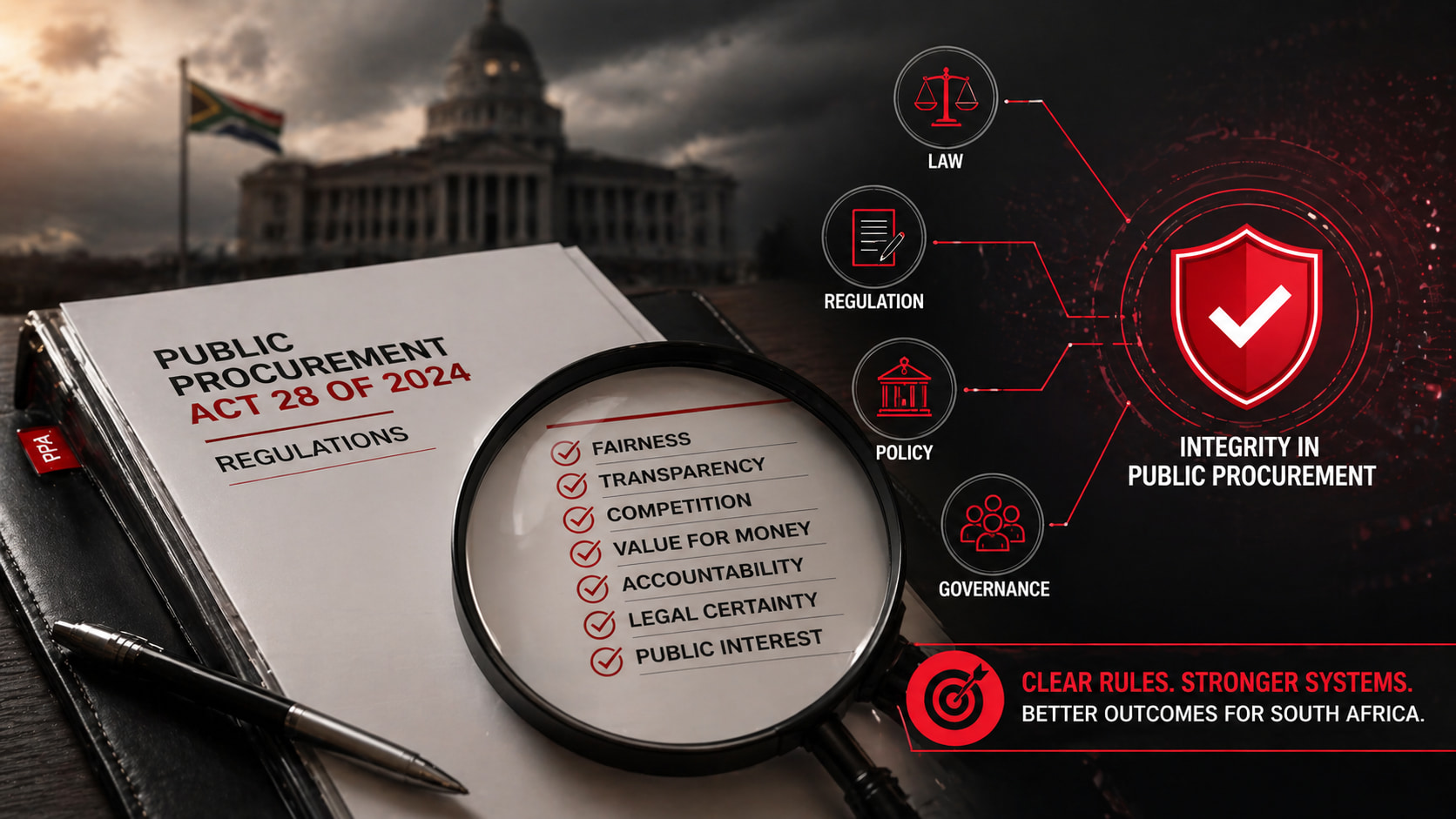
The Public Procurement Act 28 of 2024 (PPA), assented to by the President on 18 July 2024, represents the most significant reform of South Africa’s public procurement legal framework in a generation. For the first time, the country will have a single primary statute governing public procurement across all spheres of government.
Critically, the PPA expressly requires the Minister of Finance to make regulations governing tender validity periods. Draft General Public Procurement Regulations have been published for public comment, with a deadline of 15 June 2026. If the regulations are drafted with the clarity and precision this area of law demands, a decade of uncertainty and commercial exploitation can be ended. If that opportunity is missed, the weapon remains in circulation.
The regulations ought to address six things directly.
- The timing rule must be codified as absolute. Extension requests must be made and consents received before the original validity period expires. Retroactive extension is not permissible under any circumstances. This is already established by the case law and must be given statutory force.
- Consent requirement must be targeted at qualifying bidders only. The request to extend must be directed only at bidders who remain under active consideration at the time the request is made. A bidder disqualified on objective, documented grounds is not a “tenderer” for this purpose and need not be approached. This resolves the Aurecon/Takubiza tension in favour of the constitutionally and practically sounder position.
- Form requirements must be explicit. Both the request and the response must be in writing. Silence is not consent. A failure to respond within the specified time is treated as a refusal.
- Consequences of refusal must be clearly defined. A bidder who refuses to extend is removed from further consideration in the current process. Their refusal does not terminate the process for other qualifying bidders. The procurement continues provided at least one qualifying bidder has consented to the extension. This directly and unambiguously removes the weapon.
- Proactive obligation must be statutory. Organs of state must be required to monitor approaching expiry dates and act timeously. The failure to manage a validity period adequately is an administrative failure; it should not be an event that hands bidders a commercial opportunity at the expense of the public purse.
- The right to re-tender must be acknowledged transparently. The regulations should expressly confirm that a bidder who refuses to extend in a process that subsequently lapses and is re-advertised is not excluded from the fresh process. This may seem counterintuitive, but the alternative, leaving it unspoken, is worse. Making the legal consequence of refusal explicit and transparent removes the fog within which the weapon currently operates. A bidder who knows that refusal means removal from the current process, and nothing more, can make an informed decision. A bidder who is uncertain about the legal consequences of refusal operates in ambiguity, and, as this article has demonstrated, it is where exploitation occurs.
Conclusion: Closing the Gap
South African public procurement law has, through a series of unresolved judicial decisions, placed a weapon in the hands of bidders that has no legitimate place in a system designed to serve the public interest. The weapon is the power to refuse consent to a validity period extension, and in doing so, to engineer the termination of a procurement process, trigger a mandatory re-tender, and return to the competition with a better price, corrected documentation, and the full benefit of everything learned in the first round.
This is not a theoretical risk. It is a rational commercial strategy, openly available, legally unassailable under the current framework, and directly contrary to the constitutional principles of cost-effectiveness and efficiency that section 217 exists to protect. Every procurement official who sends an extension request without understanding this dynamic is exposed. Every organ of state that allows a validity period to lapse through administrative inattention has handed the advantage to precisely those bidders who were not winning.
The case law has been analysed at length elsewhere. The competing judgments have been mapped, the tensions identified, and the preferred positions argued. What has been missing from the discourse is a clear-eyed account of what the uncertainty produces in practice, what it puts in bidders’ hands, and what it costs the public. That is what this article has sought to provide.
The Public Procurement Act 28 of 2024 and its forthcoming regulations offer a genuine opportunity to end this. The regulations must codify the Aurecon principle, clearly define the consequences of refusal, and remove the ambiguity under which strategic non-consent has operated freely. The goal is not merely legal certainty for its own sake. It is a procurement system that cannot be gamed, one in which the rules are clear, the consequences are predictable, and the public interest is protected rather than exploited.
The most effective procurement systems in the world are those in which the rules leave no room for manipulation. South Africa has the legislative moment, the legal framework, and the evidence of a decade of exploitation to draw on. The regulations must rise to that moment.