
Construction adjudication in South Africa has become one of the most commonly invoked dispute resolution mechanisms in the industry. Positioned as a fast, cost-effective alternative to construction arbitration or litigation, it promises swift decisions that keep projects moving and cash flowing. In theory, it is the perfect remedy for an industry notorious for complex disputes, long project cycles, and contractors who cannot afford to wait years for a tribunal to decide who is owed what.
But speed, it turns out, is not the same as resolution. And in practice, construction adjudication in South Africa delivers very different outcomes depending on a range of factors that have little to do with the law itself.
“Speed, it turns out, is not the same as resolution.”
The Contractual Foundation Matters More Than Many Realise
The effectiveness of adjudication is heavily shaped by the contractual framework within which a dispute arises. The NEC3 and NEC4 suites, for instance, build adjudication into the project management lifecycle in a structured way, with clear compensation event procedures that are intended to reduce the incidence of disputes in the first place. The JBCC and FIDIC forms take different approaches to when and how adjudication can be triggered, and who bears procedural responsibility for making it work.
What this means in practice is that parties on one contract may find adjudication a genuinely efficient process, while parties on a different project, even of similar scale and complexity, may find it frustrating, inconclusive, or simply the opening move in a longer legal battle. The mechanism does not operate in isolation from the document that authorises it.
It is also worth noting that many disputes in South Africa arise on contracts where the adjudication provisions are either absent, poorly drafted, or inconsistently applied. In those circumstances, the parties may default to ad hoc arrangements, which are less predictable and more susceptible to procedural challenge.
When the Process Works — and When It Does Not
Adjudication tends to be most effective when the dispute is contained: a payment certification disagreement, a specific extension of time claim, a defined contractual entitlement. Where the facts are not heavily contested, where the adjudicator has relevant technical expertise, and where both parties genuinely wish to resolve the matter and move on, the process can be remarkably effective. A decision issued within the contractually prescribed timeframe, 25 working days from the referral date under the JBCC Adjudication Rules, or 28 calendar days from the referral date under NEC3 and NEC4 Option W1, with binding interim effect, can unblock a project that might otherwise stall for months.
The picture is more complicated when disputes involve multiple overlapping claims, significant factual disputes, or where the relationship between the parties has deteriorated to the point that neither side is engaging in good faith. In these situations, the compressed timeframe that makes adjudication attractive also becomes its greatest limitation.
The result, in some cases, is a decision that technically resolves the dispute in the short term but does not address its underlying causes, leading to further claims, further adjudications, and eventually, arbitration or litigation anyway. The process has not failed in a legal sense, but it has not produced the finality that the parties needed.
“Is the compressed timeframe that makes adjudication attractive also its greatest limitation — or simply a constraint that rewards better preparation?”
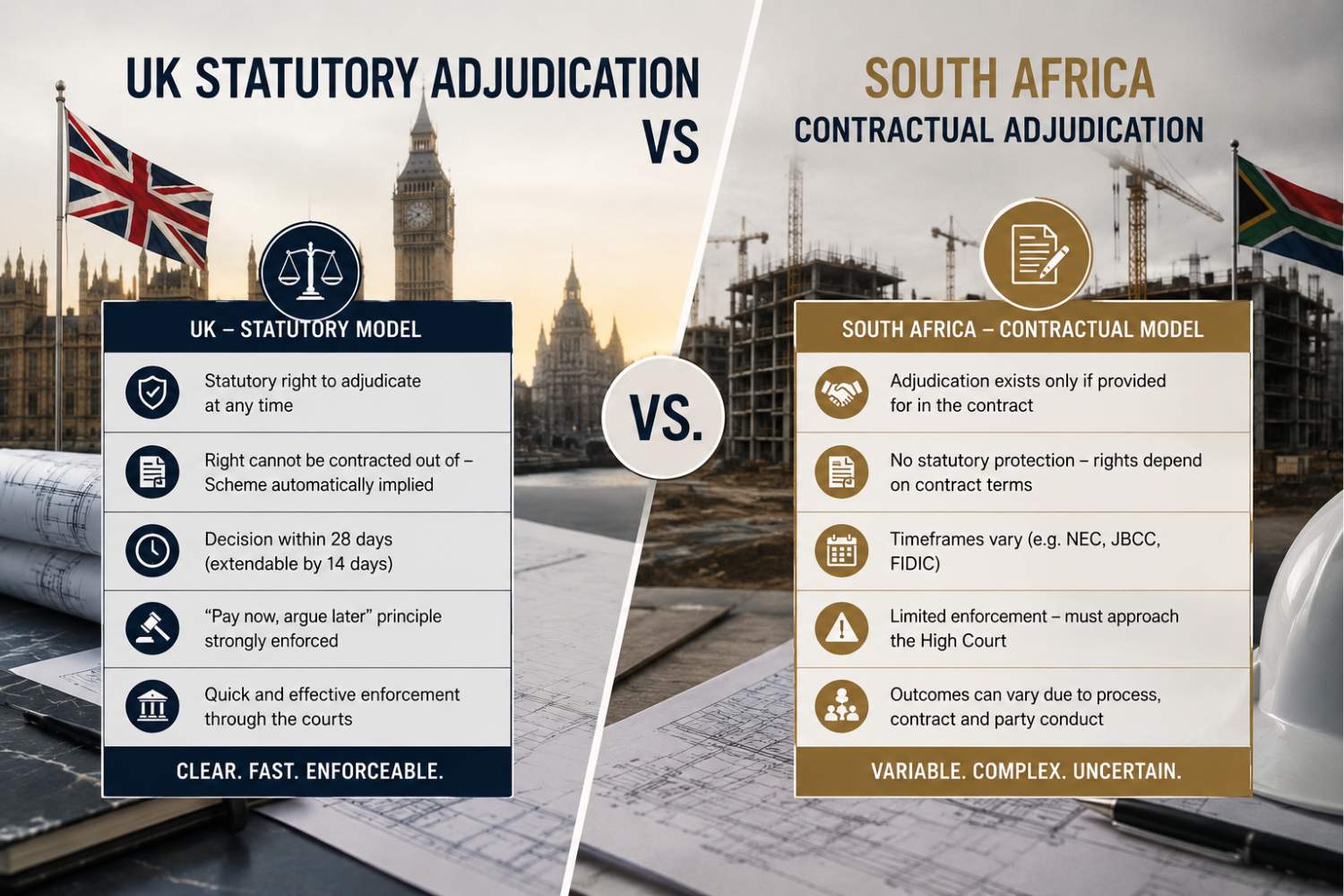
The UK Model: What Statutory Adjudication Looks Like in Practice
The contrast with the United Kingdom is instructive. Following Sir Michael Latham’s landmark 1994 report, “Constructing the Team,” which described the construction industry as adversarial, fragmented, and incapable of delivering for its customers, the UK Parliament enacted the Housing Grants, Construction and Regeneration Act 1996, commonly known as the Construction Act. Part II of the Act came into force in May 1998 and fundamentally changed how construction disputes are resolved.
Under the Construction Act, any party to a qualifying construction contract has a statutory right to refer a dispute to adjudication at any time, regardless of what the contract says. If the contract does not contain compliant adjudication provisions, the Scheme for Construction Contracts is automatically implied. This means the right to adjudicate cannot be contracted out of, and no party can be denied access to the process by a poorly drafted or silent contract. The adjudicator is required to reach a decision within 28 days of referral, extendable by 14 days with the consent of the referring party. The decision is binding on an interim basis and must be complied with immediately, pending any final resolution by arbitration, litigation, or agreement.
In practice, the UK statutory model has proven highly effective. The “pay now, argue later” principle is robustly enforced by the courts, and enforcement applications are dealt with swiftly, typically by way of summary judgment. The UK Technology and Construction Court has consistently refused to look behind an adjudicator’s decision except in narrow circumstances involving jurisdictional error or a breach of natural justice. This has given the process teeth: parties know that a determination, even an imperfect one, will be enforced, and that attempting to resist or delay compliance carries real legal risk including adverse costs orders.
South Africa has no equivalent legislation. Adjudication here remains entirely contractual, it exists only because the parties’ contract provides for it, and its procedural framework varies across the JBCC, NEC, FIDIC, and other standard forms. A proposal to introduce mandatory statutory adjudication was published for comment by the Department of Public Works over a decade ago but was never enacted. Whether that represents a missed opportunity or a reasonable reflection of local conditions is a matter on which practitioners hold genuinely different views. Some argue that legislation would bring the uniformity and enforceability that the current system lacks; others contend that a contractual framework, properly drafted and engaged with in good faith, is sufficiently flexible to meet the industry’s needs without the rigidity that statute can introduce. The UK experience is instructive, but it is not necessarily a template.
Construction Adjudication vs Construction Arbitration: Understanding the Difference
Construction arbitration is often the mechanism parties turn to when construction adjudication in South Africa has not provided a lasting resolution, or when the stakes are high enough to warrant a more thorough process from the outset. It offers a final and binding award, broader procedural powers, the ability to conduct extensive oral hearings, and greater scope for expert evidence. For complex, high-value disputes, these features are often worth the additional time and cost.
The trade-off is significant, however. An arbitration conducted under the auspices of the Association of Arbitrators (Southern Africa) or under ad hoc rules can take years to conclude. Legal costs escalate quickly. For a contractor who is owed money and needs it to fund the next project, arbitration can feel like a remedy that arrives too late to matter.
This is not an argument for construction adjudication over construction arbitration, or vice versa. It is an argument for choosing the right mechanism for the right dispute. The two are not always alternatives. Construction adjudication in South Africa often precedes arbitration, and the adjudicator’s decision, while binding in the interim, can be revisited and overturned by an arbitral tribunal. Understanding this relationship is important for parties who view an adjudication outcome as the end of the road when it may, in fact, be only one stage in a longer process.
An Illustrative Pattern from Practice
A recurring problem in practice involves NEC3 contracts, where the adjudicator’s decision creates an immediate contractual obligation on the employer to make payment. Under Option W1, that obligation is clear: the adjudicator’s decision is binding, and compliance is not discretionary. In theory, this is the fast-track mechanism working exactly as intended, a dispute is referred, a decision is rendered within the prescribed timeframe, and the successful party receives payment without delay.
In practice, however, employers frequently do not pay. Whether out of a genuine belief that the decision is wrong, a desire to preserve cash flow, or simple intransigence, the contractual obligation is ignored. The successful party, perhaps a contractor or subcontractor already under financial pressure, is then left with no choice but to approach the High Court for an enforcement application, compelling the employer to comply with the adjudicator’s determination.
This enforcement step is where the promise of speed and efficiency begins to unravel. Court rolls are congested, and an enforcement application requires the preparation of founding papers, the engagement of legal counsel, filing, and then waiting for a hearing date, a process that can, in practice, take well in excess of a year to conclude. Costs accumulate. Weeks, and sometimes months, pass. What was intended to be a rapid resolution of a payment dispute becomes a second set of proceedings layered on top of the first, with all the attendant expense, management time, and frustration. The party that won the adjudication is paradoxically worse off than if the process had proceeded directly to arbitration, where at least the resulting award carries immediate executory force.
The irony is not lost on those who have been through it. Adjudication’s core value proposition is speed. When enforcement requires a court application, that proposition is significantly undermined. This is an area where the absence of a statutory framework in South Africa is felt most acutely, in the UK, the courts’ robust and well-established approach to summary enforcement of adjudicators’ decisions means that non-complying parties face swift and predictable consequences. In South Africa, the enforcement route, while ultimately available, is neither swift nor costless, and the burden falls entirely on the party that has already had to fight once to establish its entitlement.
What Influences Outcomes in Practice
Beyond the contractual framework and the nature of the dispute, several other factors shape how adjudication plays out. The experience and technical competence of the adjudicator is critical. A technically skilled adjudicator who understands construction economics and programming will reach more defensible decisions than one who is legally qualified but unfamiliar with industry practice.
The quality of the referral documentation matters enormously. Parties who have maintained thorough contemporaneous records, properly notified claims in accordance with contractual requirements, and presented their case clearly are far better positioned than those who have not. Adjudication rewards preparation, even within its compressed timeframe.
Finally, the attitude of the parties themselves has an outsized influence. Where both parties approach adjudication as a genuine attempt to resolve a dispute, it tends to produce useful outcomes. Where one or both parties treat it as a tactical step, a way to delay, or to create pressure, or to obtain a result they can exploit in later proceedings, the process becomes adversarial in ways it was not designed to accommodate.
Reflections: Questions Worth Asking
Construction adjudication in South Africa occupies an interesting and somewhat contested space. For many practitioners, it remains an indispensable mechanism, imperfect in places, but capable of delivering real value when the circumstances are right and the parties engage with it properly. For others, the enforcement gap, the absence of a statutory framework, and the compressed timeframes raise genuine questions about whether the process reliably delivers what it promises. Both perspectives have merit, and the tension between them is worth sitting with rather than resolving too quickly.
Perhaps the more productive questions are these: Is construction adjudication being used in South Africa in the circumstances it is best suited to, or has it become a default step that parties invoke without sufficient thought about whether it is the right tool for their dispute? Where it falls short, whether in enforcement, in timeframes, or in the quality of outcomes, are those failures of the mechanism itself, or of how it is being used? And if the answer is the latter, what would need to change in how parties, advisers, and adjudicators approach the process for its potential to be more consistently realised? These are not questions with easy answers. But they may be more useful starting points than a simple verdict on whether construction adjudication in South Africa works.
References and Further Reading
NEC, NEC3 Engineering and Construction Contract, Option W1: Dispute Resolution (NEC, London).
NEC, NEC4 Engineering and Construction Contract, Option W1: Dispute Resolution (NEC, London).
Construction Industry Development Board (CIDB), Best Practice Guideline C3: Adjudication (CIDB, Pretoria).
United Kingdom Parliament, Housing Grants, Construction and Regeneration Act 1996, Part II: Construction Contracts, as amended by the Local Democracy, Economic Development and Construction Act 2009 (HMSO, London).
Latham, M (Sir), Constructing the Team: Final Report of the Government/Industry Review of Procurement and Contractual Arrangements in the UK Construction Industry (HMSO, London, 1994).
Maritz, M J, “Adjudication in the South African Construction Industry” (2007) Acta Structilia 14(2).
ICE-SA (Institution of Civil Engineers South Africa), NEC Adjudication under Option W1 in South Africa