
In twenty years of construction law practice, one pattern has repeated itself more reliably than any other: by the time a contractor calls me, the contract has already done most of its damage. The variation was instructed months ago. The notice was not given. The programme was never updated. The dispute, which is now heading toward adjudication or arbitration, has its roots in a document signed at the beginning of the project and, in many cases, barely read.
This article is written for contractors and subcontractors who want to change that pattern. Not because the law requires it, but because understanding the contract you are signing, and getting proper advice on contract drafting, is the single most effective risk management tool available to you, and it costs nothing except the time to think carefully before pen meets paper.
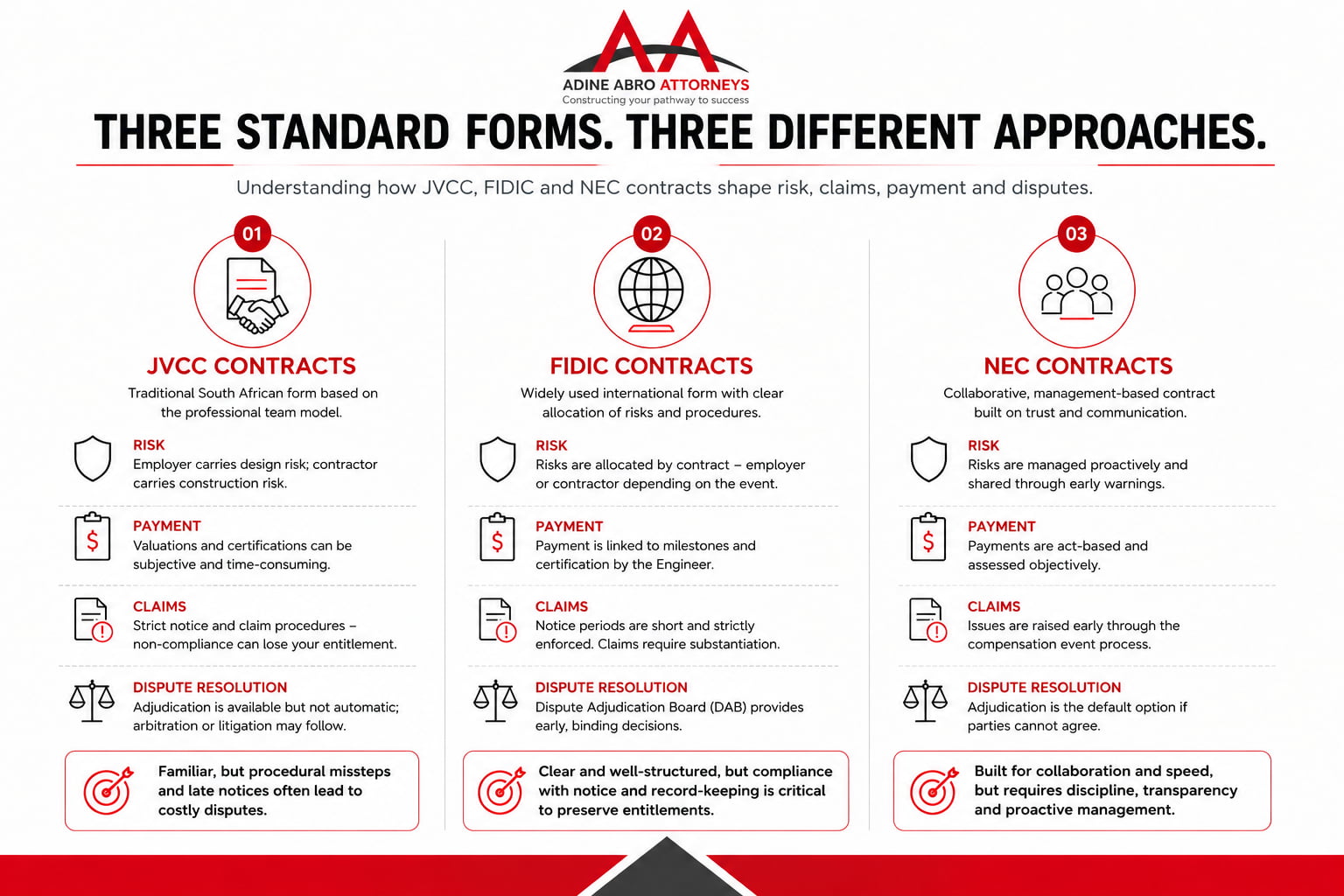
We will work through the three standard forms most commonly encountered on South African projects: JBCC contracts, FIDIC contracts and NEC contacts. Not as an academic exercise in comparing clause numbers, but as a practical examination of how each contract affects your risk, your cash flow, your ability to claim, and your options when things go wrong.
Before you read further: do you know which contract form governs your current project, and have you read the particular conditions as well as the general conditions?
1. The Choice That Shapes Everything
It’s tempting to treat the selection of a standard form contract, whether JBCC, FIDIC or NEC, as a formality: a box to tick in the procurement process. In practice, that choice determines how variations are priced, how delays are compensated, who bears the risk of unforeseen ground conditions, how disputes are initiated, and how long your money takes to arrive. It is not a formality. It is the architecture of the entire commercial relationship.
Let me be clear about something from the outset: contractors and subcontractors do not, as a rule, choose the contract form. That decision belongs to the procuring entity, the employer, the developer, the state organ, or the main contractor imposing a back-to-back arrangement. By the time the tender documents land on your desk, the form has already been selected. You did not pick it, and in most cases, you cannot change it. What I have observed over many years, however, is that this reality is used as a reason not to engage in the contract at all, and that is where the damage is done. You may not choose the form, but you choose whether to understand it before you sign it. You choose whether to price it correctly, given the risks it entails. You choose whether to build the administrative disciplines it requires into your project from day one. Those choices, made before execution, are where your protection lies.
Each of these choices, and each of these failures, has a cost. Let me walk you through what that cost looks like in practice.
2. JBCC: Familiar Territory, Familiar Traps
The contract most South African contractors know best
The JBCC Principal Building Agreement is one of the most commonly used forms on domestic building contracts in South Africa. Most building contractors and their subcontractors have worked under it many times. That familiarity is valuable. It also breeds a particular kind of carelessness.
Because contractors know the JBCC, they sometimes stop reading it carefully. They assume the form they signed this year is the same as the one they signed five years ago, or that the particular conditions attached by this employer are broadly similar to those they have seen before. Those assumptions are frequently wrong, and the consequences of getting them wrong show up at the final account stage, when disputes that could have been avoided at the outset become expensive to resolve.
When was the last time you read the particular conditions of a JBCC contract from beginning to end before signing? If the answer is “not recently” that is where disputes are born.
How the JBCC allocates risk
The JBCC operates on a traditional professional team model. The employer appoints a principal agent, typically an architect or project manager, who administers the contract: issuing Contract Instructions, certifying payment, and making determinations when the parties disagree. The contractor is responsible for the execution of the construction. The employer carries the design risk where the design is provided by the employer’s professional team.
This structure works well when the professional team is competent, independent, and timely. When it is not, and there are projects where it is not, contractors find themselves in a difficult position. The principal agent is the employer’s agent, appointed and paid for by the employer. The contract requires the principal agent to act fairly, but there is often no practical independent check on whether they are doing so until adjudication or another dispute is invoked.
I have acted for contractors on JBCC projects where the principal agent certified payment months late, where Contract Instructions ordering variations were executed without the valuation of those variations being agreed or even formally disputed at the time, and where extensions of time were withheld despite clear employer-caused delay. In each of those cases, the contractor’s failure to invoke the contract’s mechanisms promptly to give written notice, to claim formally, to request adjudication, weakened their position significantly by the time legal advice was sought.
| THE CONTRACT INSTRUCTION PROBLEM |
| Contractors frequently accept Contract Instructions that vary the work without agreeing a price beforehand, assuming the matter will be settled at final account. In practice, final account negotiations on the pricing of Contract Instructions are where months of site-level agreement unravel. If you have not recorded your position in writing when the instruction is issued, you have already lost ground. |
Where JBCC is not the right tool
The JBCC was designed for building contracts with a traditional procurement route: employer-provided design, fixed-price construction, and professional team administration. Applied outside that model, it starts to show limitations.
I have advised on projects where JBCC was used for work that was effectively design-and-build in substance, without adjusting the contract to clearly allocate design responsibility. The result was a dispute at practical completion about whether defects were design defects (the employer’s problem) or workmanship defects (the contractor’s problem). The contract did not provide a clear answer because the question it was designed to address differed from the one the project raised.
If the project you are pricing involves significant design responsibility, employer-supplied materials or equipment, or a procurement model that materially departs from the traditional approach, consider whether the JBCC is genuinely the right form or simply the familiar one.
3. FIDIC: Powerful Protections, Strict Obligations
Why FIDIC is different
FIDIC contracts, most commonly the Red Book for civil and infrastructure work, and the Yellow Book for design-and-build, are used extensively on South African public infrastructure projects, often as a requirement of multilateral development bank funding. If you tender for state infrastructure work or internationally funded projects, there is a good chance you will encounter FIDIC.
FIDIC offers some genuine advantages for contractors compared to domestic building contracts. The Red Book’s provisions on unforeseeable physical conditions (Sub-Clause 4.12) give contractors a path to additional time and money when ground conditions differ materially from what a reasonable contractor could have anticipated. That protection does not exist in equivalent form under JBCC. On infrastructure projects where ground conditions carry real uncertainty, and in South Africa, they often do, that difference is not trivial.
FIDIC also contains a more developed extension of time and delay damages framework than JBCC, and its payment provisions, when properly administered, provide a reasonably contractor-friendly basis for valuations and certifications.
This article is based on the FIDIC 2017 Second Edition, which remains the modern reference point for current drafting. If you are working on an older project still governed by the 1999 edition, the structural framework is similar, but the claims procedure differs materially in how the engineer’s determination function operates and in the time-bar provisions.
Do not assume the two editions are interchangeable. If you are unsure which edition governs your project, that is the first thing to establish.
The employer’s particular conditions (part a – contract data and part b – special provisions): reading the small print
One of the most consistent sources of disputes I see on FIDIC projects is the relationship between the general conditions and the employer’s particular conditions. FIDIC’s general conditions are a carefully balanced set of rights and obligations. Employers, often with the assistance of consultants who have a vested interest in the outcome, frequently modify those conditions in ways that shift risk significantly onto the contractor.
I have reviewed FIDIC particular conditions that reduced the notice period from 28 to 14 days, effectively halving the time within which a contractor must act to preserve its entitlement. Others remove the engineer’s independent certifying function entirely, making the engineer an agent of the employer for all purposes. Still others cap the contractor’s entitlement to loss and expense in ways that the general conditions do not contemplate.
The particular conditions are not standard. They are bespoke. You should read these documents most carefully, because they are specifically designed to limit what the general conditions would otherwise give you.
Have you compared the employer’s particular conditions in your current FIDIC contract against the general conditions, clause by clause? If not, you do not yet know what contract you have actually signed.
The engineer’s role and its limits
FIDIC places enormous responsibility on the engineer. Under the general conditions, the engineer is required to act neutrally when making determinations. Not as the employer’s representative, but as an independent professional giving each party what the contract entitles them to. This is a significant obligation, and one that not all engineers appointed to South African projects discharge effectively.
FIDIC 2017 introduced deeming provisions specifically to address engineer inaction. Where an engineer fails to respond to a claim or issue a determination within the prescribed period, the contract deems a response to have occurred, thereby triggering the contractor’s right to refer the matter to the DAAB. On the face of it, this protects the contractor.
In practice, it creates a risk of its own. A contractor who does not know the deeming provisions exist may simply wait for a response that the contract already treats as having been given. By the time that is understood, the period within which the deemed rejection must be referred to the DAAB may have passed. The protection that FIDIC 2017 built in for the contractor’s benefit has become the mechanism by which the contractor loses its right to pursue the claim. The risk, in other words, has not disappeared; it has shifted.
Under FIDIC 2017, the contractor who does not actively monitor the engineer’s response periods is as exposed as the contractor who fails to give notice in the first place.
4. NEC: The Contract That Asks the Most of Everyone
A different philosophy
NEC4 represents a deliberate attempt to change the culture of construction contracting. Where JBCC and FIDIC are essentially claims-management frameworks built around dispute resolution, NEC is designed around the proposition that transparent, collaborative management of risk and change produces better outcomes than adversarial accumulation of claims.
The core of NEC is a mutual obligation to act in a “spirit of mutual trust and co-operation”. That phrase is sometimes dismissed as aspirational, but it has substantive legal weight. Courts and adjudicators have considered what it requires, and it is capable of shaping how the parties’ obligations are interpreted in practice. For contractors, this includes a duty to raise problems early rather than accumulate them, to provide accurate information for compensation event assessments, and to maintain the programme in a way that reflects the actual project status.
If you are on an NEC project, when did you last update the accepted programme? When did you last issue an early warning? If you cannot answer both questions with confidence, you may not be administering the contract in a way that protects your entitlements.
The compensation event machine: how it works and why it fails
The compensation event (CE) mechanism is the engine of NEC’s change management process. When something happens that entitles the contractor to additional time or money, it is recognised as a compensation event, and the contractor submits a quotation, setting out its time and cost impact within three weeks of notification. The project manager responds within two weeks. If the process works, changes are priced and agreed in real time, and no one is surprised at final account.
In practice, this system breaks down on South African NEC projects with remarkable frequency, and the failure mode is almost always the same: neither party administers the contract with the discipline it requires. The contractor does not submit quotations on time. The project manager does not respond within the required period. The accepted programme is not maintained. And then, a year into the project, both parties find themselves in a dispute not just about the underlying entitlement but also about the correct procedural baseline.
The irony is significant: NEC is designed to prevent the accumulation of claims. Poorly administered NEC projects often produce exactly that outcome, with the additional complexity that the parties are now in dispute about process as well as substance.
| THE NEC DISCIPLINE REQUIREMENT |
| NEC does not work as a passive contract. You cannot sign it, proceed with the project in a conventional way, and then rely on its provisions at the end. The compensation event procedure, the early warning register, and the programme updates are not administrative formalities. They are the mechanism through which your entitlements are established. If you are not using them correctly, you are not using the contract correctly. |
What NEC means for subcontractors
If you are a subcontractor on an NEC project, you face a particular challenge. The main contractor has NEC obligations upstream with the employer, and NEC back-to-back obligations downstream with you. The compensation event timelines are tight. When a CE arises at your level, the main contractor needs your quotation promptly to pass it upstream within the required period.
Subcontractors who do not understand the CE process often find that their entitlements are lost, not because the main contractor is dishonest, but because they did not provide what was needed on time. The main contractor made a CE determination without adequate information from the subcontractor because there was no time to wait, and that determination became the baseline for the upstream submission.
If you are being asked to work under an NEC back-to-back arrangement, understand the timeline obligations before you sign. Ask the main contractor how they administer CEs. Ask whether there is a standing agenda for early warning meetings. Ask how the accepted programme is maintained. The answers to those questions will tell you whether the project is genuinely NEC-administered or merely NEC-labelled.
Is your back-to-back subcontract a genuine NEC arrangement, or does it simply import NEC risk allocation without the corresponding NEC management infrastructure? The two are not the same.
5. The Administrator’s Independence: A Problem Across All Three Forms
I raised the tension between financial dependence and contractual independence when discussing the JBCC principal agent. But I want to be precise about something: this is not a JBCC-specific problem. It runs through all three standard forms, and it is one of the most practically significant structural tensions a contractor will encounter, regardless of which contract governs the project.
- Under JBCC, the principal agent is appointed and paid by the employer.
- Under FIDIC, the engineer is appointed and paid by the employer.
- Under NEC, the project manager is similarly appointed and remunerated by the employer.
In each case, the contract requires that person to perform certain functions independently: to certify what is due, to assess entitlements, to make determinations that may go against the very party paying their fee. That is a structural tension, and pretending it does not exist does a disservice to contractors trying to understand how their project will be administered.
The obligation of independence is genuine and legally enforceable. A principal agent who certifies short without proper cause, an engineer who issues a determination that ignores the contractor’s submissions, or a project manager who declines to recognise a compensation event for reasons that have no contractual basis may be acting in breach of the contract. The contractor has remedies. But those remedies require invoking the dispute resolution mechanism, which takes time and money and carries its own commercial risks.
The practical reality is that many contractors absorb the consequences of an administrator’s partiality rather than formally test their rights, and that tolerance is exactly what some administrators and employers rely upon.
On your current project, does the administrator, whoever that person is under your contract, understand that their obligation of independence is owed to both parties? And if they have fallen short of that obligation, do you know how to invoke your right to challenge their determination?
There is a further dimension worth noting. FIDIC is explicit that the engineer must act neutrally when making determinations under Sub-Clause 3.7. The JBCC requires the principal agent to act reasonably and in good faith. NEC imposes an obligation of good faith on the project manager, embedded in the overarching requirement of mutual trust and co-operation. These are not soft obligations. They have been tested in adjudication and arbitration proceedings, and administrators who depart from them do so at legal risk to their clients.
For contractors, the practical implication is this: where an administrator’s determination is wrong, you are not without recourse simply because the determination has been issued. Challenge it through the correct mechanism, within the correct period. Document your objection at the time. Do not allow incorrect determination to become the unchallenged baseline for the rest of the project. The passage of time and the accumulation of subsequent events make it progressively more difficult to revisit an earlier determination, even a wrong one.
6. Three Questions You Should Ask Before You Sign Any Contract
Regardless of which standard form governs your project, there are three questions I would ask every contractor and subcontractor to apply before executing the agreement. They are not complicated. But answering them honestly requires the willingness to read the document, and to raise issues before the pressure of a start date makes everything feel non-negotiable.
Question one: Who is responsible for what, and is that reflected in the price?
Every construction contract allocates risk. The question is not whether risk is allocated, but whether the allocation is clear and whether your price reflects it. If the contract places design risk on you, does your price include the cost of that risk? If the contract requires you to accept unforeseen ground conditions, does your rate include a contingency for that exposure?
Know what you are taking on before you price it. The contract tells you. Read it.
Question two: What do I have to do, and when, to preserve my entitlements?
Every standard form imposes procedural requirements on the contractor. Notice periods. Claim submission deadlines. Programme obligations. Early warning duties. These are not aspirational guidelines. They are conditions of entitlement.
Before you sign, identify the key procedural obligations and build compliance into your project management system from day one. Who gives notices? By what date after what triggering event? Who maintains the programme? Who attends early warning meetings? The answers need to be in place before the project starts, not after the first dispute arises.
Question three: How do I get paid, and what happens if I don’t?
Payment provisions vary significantly across the three forms. Understand the valuation cycle, the certification timeline, the interest provisions for late payment, and the circumstances in which you can suspend for non-payment. Also, understand which dispute resolution mechanism applies when payment is withheld and how quickly you can access it.
On FIDIC 2017 projects in particular, contractors sometimes do not realise that there is a specific procedure for raising payment disputes and that adjudication is the fastest route to recovery, requiring compliance with the contract’s DAAB provisions. If the DAAB was never constituted because no one got around to it at the start of the project, your dispute resolution options may be slower and more expensive than you assumed.
7. The Cost of Getting Legal Advice Too Late
The construction industry has a longstanding reluctance to involve lawyers at the contracting stage. Legal fees seem unnecessary when the project has not yet started and relations between the parties are good. I understand the reasoning and the commercial pressures behind it. I do not agree with it.
In my experience, the cost of proper legal review at the contract stage is often a very small fraction of the cost of resolving disputes that arise from contract provisions that could have been identified and addressed before signature. Employer-drafted particular conditions that quietly cap your extension-of-time entitlement, limit your delay-damages exposure, or remove the independent certifier’s function are clearly visible in the document. They can be negotiated, qualified, or, at a minimum, flagged as a known risk before the contract is signed. Once the contract is signed, it can only be litigated.
This is not a plea for lawyers to be present at every commercial decision. It is an argument that the contracting stage, particularly for contracts of significant value, or contracts under unfamiliar forms, is precisely the moment when specialist legal input delivers the most value per rand spent.
Think about the last significant dispute you were involved in. How much of it had its roots in the contract you signed at the beginning of the project? Could any of it have been avoided or mitigated if the contract had been carefully reviewed before execution?
If the answer is yes, and in my experience, it very often is, then the investment in legal review at the outset was not a cost at all. It was the cheapest line item in the project budget.
Closing Thoughts
The contract you sign is the project you get. That is not a dramatic overstatement. It is what I have observed, case after case. The standard form chosen, the particular conditions accepted, the procedures understood or misunderstood, determine the legal landscape within which every subsequent event on the project will be interpreted.
The JBCC, FIDIC, and NEC contracts are not interchangeable tools. Each has a specific sphere of application, specific obligations, and specific consequences for those who do not administer it correctly. The contractor who invests the time to understand which form they are working in, what it requires of them, and how it protects them is not merely better informed. They are genuinely better positioned to complete the project profitably, to recover what they are entitled to, and to manage disputes when they arise.
Understanding your contract is not a luxury. It is the foundation on which everything else is built.