
Construction Mafia disruption has become one of the most significant operational and commercial risks affecting South African construction projects. Standard construction contracts were not designed to cater specifically for organised criminal interference, leaving contractors and employers exposed to uncertainty when projects are disrupted.
South African construction contracts are sophisticated instruments. They allocate risk between parties with considerable precision, define notice obligations and provide structured mechanisms for resolving disputes when something goes wrong. What they do not do, and what none of the standard forms currently in widespread use specifically caters for, is tell either party what to do when an organised criminal network shuts down their site.
This is not a theoretical gap. The disruption caused by groups operating under the broad label of the ‘Construction Mafia’ is among the most significant operational risks on large construction projects across Gauteng, KwaZulu-Natal, and the Eastern Cape. Sites have been stopped for weeks at a time. Workers have been intimidated, and in many cases, the commercial consequences of that disruption have been absorbed silently, by contractors, without recovery, not because recovery was impossible in principle, but because the contractual machinery available was inadequate to the task.
This article examines how major contract forms operating in the South African market may be considered in the context of Construction Mafia disruption, highlights the contractual gap that remains, and sets out what a workable contractual and commercial response might look like.
WHAT THE CONSTRUCTION MAFIA ACTUALLY DOES TO A PROJECT
The term ‘Construction Mafia’ has become shorthand for a diverse set of actors and tactics, but the commercial effect is consistent: the suspension of productive work on a construction site, through means that the contractor can neither anticipate with precision nor resolve through standard project management tools.
The disruption typically begins with a demand for subcontract work to be awarded to specified entities, for local labour to be engaged at above-market rates, for materials to be sourced through nominated suppliers, or for direct cash payments framed as community contributions or levies. When these demands are not met, site access is physically obstructed, workers are threatened, and plant is prevented from operating. In some cases, site infrastructure has been damaged. In several documented instances, senior site personnel have been subjected to direct physical threats.
The contractor’s position during a stoppage of this kind is commercially acute. Preliminaries and general costs continue to accrue. Retained labour sits idle. Plant stands. Subcontractors claim delay costs. The programme erodes. And the contractor has no mechanism within the standard project management toolkit to address the cause, because the cause is not a design issue, not an employer instruction, and not a weather event. It is organised criminal coercion.
“The result is a risk that is effectively unallocated, sitting in the space between the contract’s categories, absorbed in practice by whoever is least able to resist absorbing it.”
HOW THE MAJOR SA CONTRACT FORMS RESPOND AND WHERE THEY FALL SHORT
The four contract forms most commonly used on South African construction projects each contain provisions that may become relevant when a site is disrupted. However, none of them specifically caters for Construction Mafia disruption.
| Contract | Applicable Clause | Potential Relevance | Gap/Limitation |
| JBCC PBA | Clause 23 – Force Majeure | General force majeure language may be considered | No specific provision for organised criminal disruption; threshold and intent uncertain. |
| FIDIC Red/Yellow 2017 | Sub-clause 18.1 – Exceptional Events | Exceptional event route may be considered | 14-day notice condition precedent strictly enforced; organised crime not listed as qualifying event. |
| NEC4 | Clause 60.1(19) – Prevention Events | Prevention event route may be considered | Requires event ‘neither party could prevent’; contractor causation arguments may arise. |
| GCC 2015 | Clause 8.3 – Excepted Risks | Excepted risk route may be considered, but narrowly | No specific provision for organised criminal disruption. |
JBCC Principal Building Agreement
The JBCC PBA’s force majeure provision, Clause 23, provides relief for events beyond the reasonable control of either party that prevent performance. In isolation, this language may be broad enough to raise an argument about organised site disruption. The difficulty is one of application. The threshold question, whether a specific Construction Mafia event was genuinely beyond the contractor’s reasonable control, or whether it could have been anticipated, mitigated, or managed, is highly fact-sensitive and untested in South African adjudication or arbitration to any meaningful degree.
There is also a deeper problem. JBCC’s force majeure provision was drafted with natural disasters, civil unrest, and sovereign action in mind. Organised criminal disruption directed at a specific project is a different category of event: it is targeted, persistent, and commercially motivated. Applying a provision designed for acts of God to acts of extortion requires an interpretive stretch that a cautious adjudicator may be unwilling to make without clearer textual support.
FIDIC Red and Yellow Books (2017 Editions)
FIDIC’s 2017 editions introduced the concept of ‘exceptional events’ under Sub-clause 18.1, replacing the earlier force majeure formulation. The clause defines qualifying events by reference to a set of listed categories: war, terrorism, riot, natural catastrophe, and similar, and a general residual category of events ‘beyond a Party’s control’ that the parties could not have provided against.
CRITICAL PROCEDURAL RISK
Under FIDIC 2017, failure to give notice within 14 days of an exceptional event is treated as a condition precedent to entitlement. International arbitral tribunals have consistently enforced this provision. A contractor who experiences a six-week Construction Mafia stoppage but fails to issue a timeous Sub-clause 18.2 notice will likely lose their entitlement entirely, regardless of the merits of the underlying claim.
NEC4
The NEC4 contract’s prevention event mechanism, Clause 60.1(19), provides one of the broader possible routes for argument among the four forms examined. A prevention event is defined as one that ‘stops the contractor completing the works’ and which ‘neither party could prevent’. This formulation, on its face, may support an argument that Construction Mafia disruption should be treated as a prevention event: neither party could prevent the criminal conduct of a third party, and that conduct directly impedes completion.
The practical difficulty is causation. An employer’s legal team will examine whether the contractor’s own conduct, in the choice of subcontractors, in the management of community relations, in the handling of initial demands, contributed to the escalation that produced the stoppage. The NEC4 framework is better positioned than JBCC or FIDIC to accommodate this category of risk, but it does not eliminate the uncertainty.
GCC 2015
The GCC 2015, used predominantly on public sector and infrastructure projects, deals with extraordinary events through the “Excepted Risks” regime in Clause 8.3. Unlike a classical force majeure formulation, Clause 8.3 does not turn on whether an event was unforeseeable or irresistible. It instead sets out a closed, defined list of excepted risks in Clauses 8.3.1.1 to 8.3.1.13, and relief depends entirely on whether the event in question falls within one of those enumerated categories. Where an excepted risk causes delay to Practical Completion or proven additional cost, Clause 8.3.2 entitles the Contractor to claim in accordance with Clause 10.1.
The consequence of this closed-list approach is that Construction Mafia disruption is protected only to the extent that it can be brought within one of the listed risks. The most plausible fit is Clause 8.3.1.4, which covers “strike, riot, commotion, disorder, violent demonstrations, sabotage or any form of civil disturbance (whether lawful or not) which is not attributable to any action or inaction of the employees of the Contractor or his Subcontractors.” Two limitations follow. First, coverage depends on whether the particular conduct can be characterised as commotion, disorder, sabotage or civil disturbance, rather than, for example, purely commercial extortion or coercion that does not manifest in those terms. Second, the proviso excludes any disturbance attributable to the conduct of the Contractor’s or its Subcontractors’ own employees. Because the clause is a defined enumeration rather than a general foreseeability test, the analysis is one of characterisation and fit, not of whether the risk has become sufficiently well-known in the South African construction environment.
WHY CONTRACTUAL AMBIGUITY PRODUCES SYSTEMATIC UNDER-RECOVERY
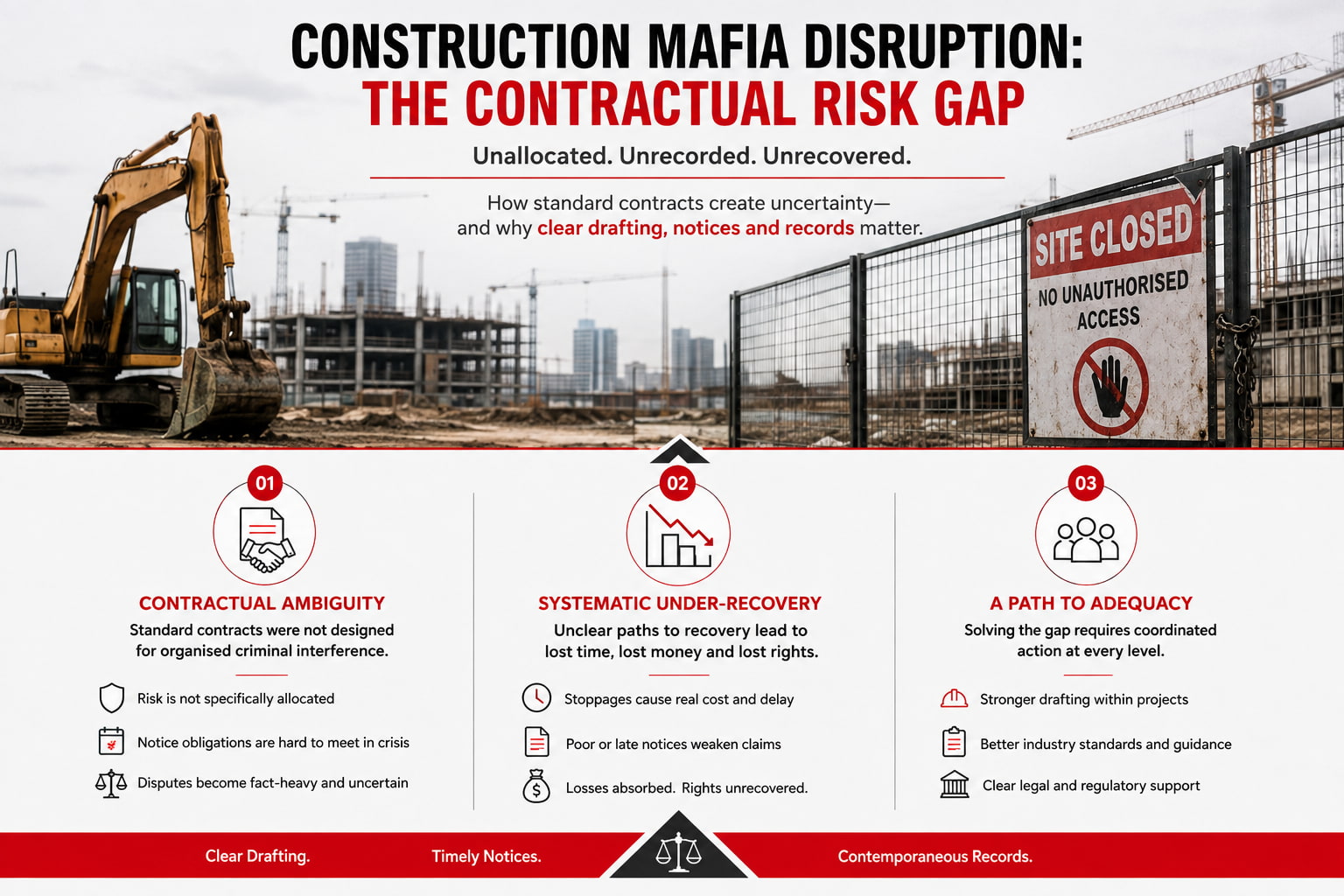
The inadequacy of current contract frameworks is not merely a legal inconvenience. It produces a predictable and systematic commercial outcome: contractors may absorb losses because the path to recovery is uncertain, fact-sensitive and likely to become disputed.
The decision not to claim is rarely made explicitly. It accumulates. The site manager focuses on resolving the immediate disruption. The commercial team, uncertain of the contractual basis, delays issuing a notice. The notice window closes. The claim is reconstructed from inadequate records. The adjudicator or arbitrator finds the evidence insufficient. The loss stays with the contractor.
This outcome is not random. It is structurally produced by a combination of three factors: contractual provisions that do not specifically cater for the risk; procedural requirements that are difficult to comply with in crisis conditions; and a cultural norm on construction sites that treats formal claims as an escalation rather than a contemporaneous management tool.
THE COMPOUNDING EFFECT
Construction Mafia disruption creates a dual commercial injury. The first is the direct cost of the stoppage: standing time, idle plant, accruing preliminaries. The second is the acceleration cost incurred when the contractor attempts to recover programme after the stoppage ends. Both costs are real. Both are largely unrecovered. And in most cases, neither is adequately documented at the time it is incurred. The total unrecovered loss across the South African construction sector from this category of disruption is not publicly quantified. It is, on any reasonable estimate, substantial.
A PATH TOWARD CONTRACTUAL AND COMMERCIAL ADEQUACY
In our experience supporting construction professionals through complex construction contract issues, proactive contract administration and contemporaneous record-keeping remain essential to preserving a party’s commercial position.
Addressing the gap requires action at three levels: within individual projects, across the industry’s standard-setting institutions, and within the legal and regulatory framework that governs construction procurement.
AT PROJECT LEVEL — WHAT PARTIES CAN DO NOW
In the absence of adequate standard form provisions, both contractors and employers can take steps within the current framework to improve their position.
- Parties should consider including a specific Construction Mafia or ‘organised third-party disruption’ clause in their special conditions of contract, clearly defining the event, allocating the risk, and specifying the notice and substantiation requirements. This is legally permissible under all four major contract forms;
- Contractors should establish a dedicated stoppage register, from day one of mobilisation, capturing every disruption event with the same rigour applied to any other claim event, recording date, duration, parties involved, demands made, responses given, and programme impact;
- Employers and their professional teams should issue formal instructions acknowledging disruption events as they occur, rather than managing them informally. A formal acknowledgement establishes a shared record that protects both parties in any subsequent dispute;
- Legal and insurance advisors should be engaged at the outset of any project in a high-risk area to assess policy coverage for criminal disruption, applicable notice requirements, and the interaction between insurance recovery and contractual entitlement.
AT INDUSTRY LEVEL — WHAT THE STANDARD-SETTING BODIES MUST ADDRESS
The Joint Building Contracts Committee, as the body responsible for the JBCC suite, is well-placed to issue a guidance note or contract amendment addressing Construction Mafia disruption directly. A specific defined term, ‘organised site disruption’ or ‘third-party criminal interference’, supported by clear risk allocation, record-keeping and procedural provisions would do more to protect the industry than any amount of after-the-fact claims consulting.
FIDIC’s next revision cycle should also consider whether the exceptional events listed in Sub-clause 18.1 adequately reflect the risks faced by contractors in emerging market and high-risk operating environments.
AT REGULATORY LEVEL — WHAT GOVERNMENT MUST CONFRONT
The Construction Mafia is, at its core, a law enforcement problem. The South African government’s response to date has not yet matched the scale and persistence of the disruption. The legal mechanisms available to contractors and employers, civil interdicts, criminal complaints, urgent applications, are available in principle but difficult to deploy in practice, particularly where the identity of those directing the disruption is obscured behind forum structures.
There is also a procurement dimension that the government has not adequately addressed. Many of the projects most severely affected are publicly funded. The failure to protect these projects from organised criminal interference is not merely a contractor problem. It is a cost imposed on the public through delayed delivery, inflated costs, and deterred investment.
THE GAP WILL NOT CLOSE ITSELF
Standard construction contracts in South Africa were not designed to manage criminal extortion. That design gap has become a commercial liability, one that is currently borne, in the main, by contractors and absorbed silently because the path to recovery is too uncertain, too procedurally demanding, and too inadequately supported by contemporaneous records to pursue.
The response to this problem cannot be left to individual project teams operating within inadequate frameworks. It requires deliberate action from the bodies responsible for those frameworks, the JBCC, the procuring authorities, and the legal profession, to update the instruments that govern commercial risk allocation in South African construction to reflect the environment in which construction actually takes place.
Until that happens, the minimum available to any contractor or employer is this: record everything, notice everything, and treat every disruption event, however unusual its cause, as a commercial event with contractual consequences. The gap in the contract is not a reason to stop recording, notifying or protecting one’s position. It is a reason to be more rigorous about the record from which any claim, defence or commercial resolution must ultimately be built.